Walk through every operation on BB17, or take the driller's chair and run the rig yourself. Free to use: register once and everything on RigVoyage opens.
Simulator 1
Rig simulator
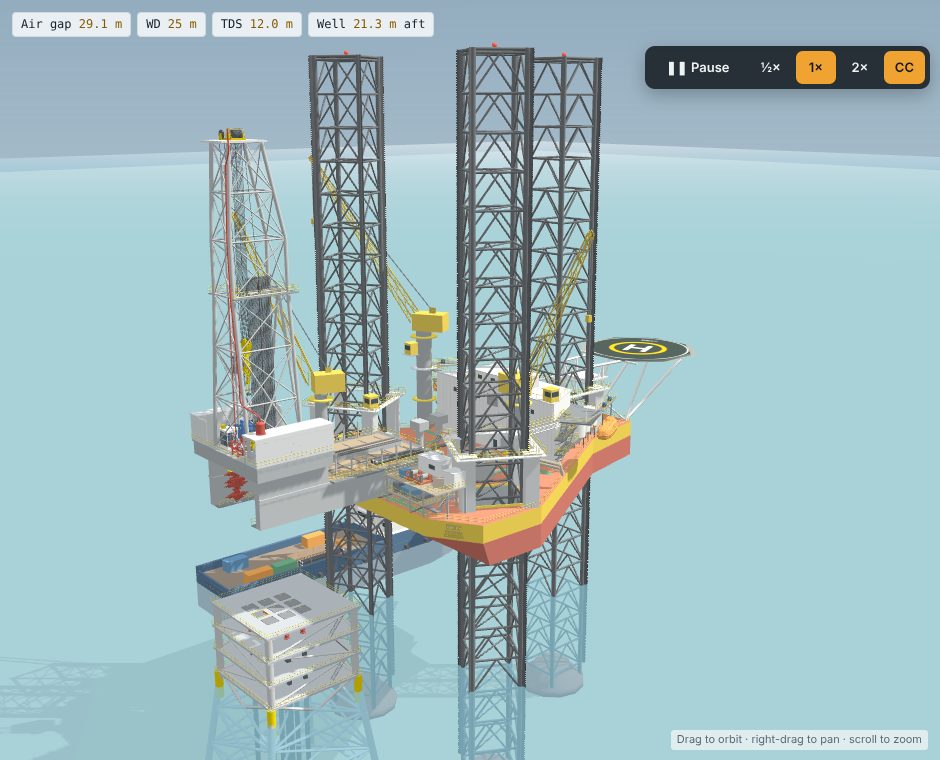
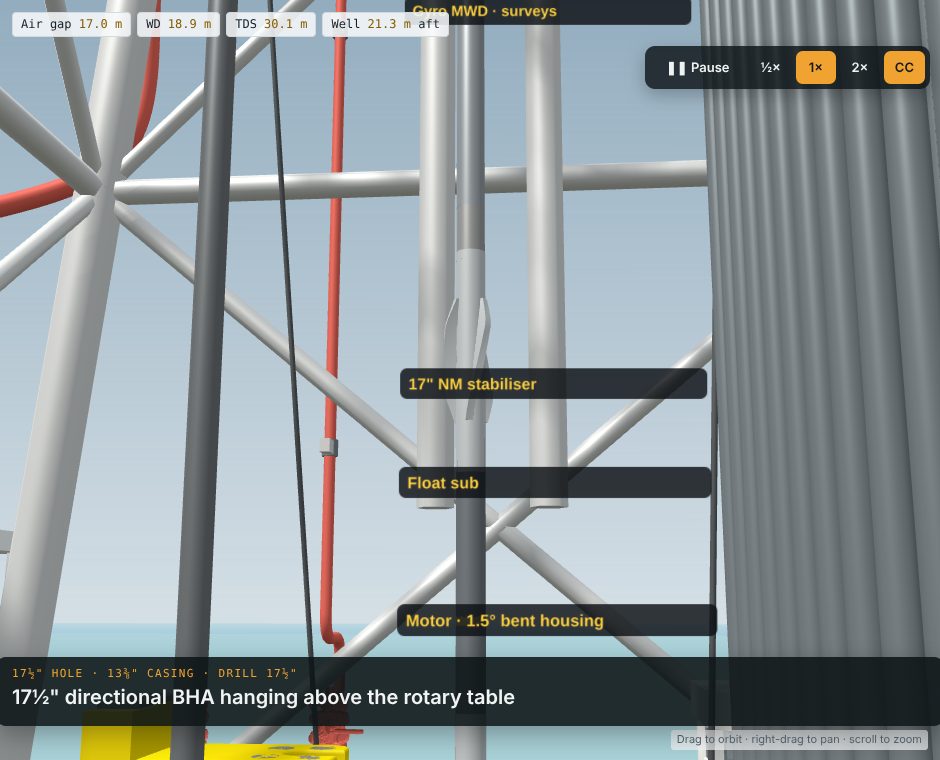
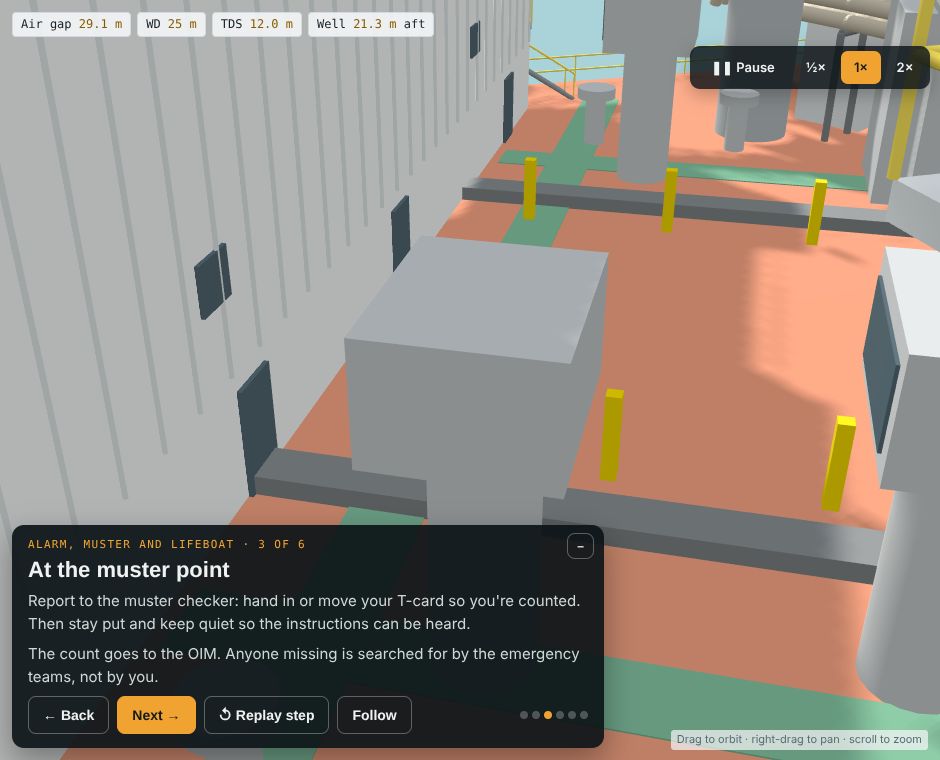
A 3D model of the BB17 jack-up you can orbit, then step through every operation from the floor and down the hole: jacking and skidding the cantilever, crane lifts, spudding the 36" hole, running and cementing each casing string, nippling up and testing the BOP, directional drilling, tripping, a gas kick killed with the Driller's method and the 7" liner.
Step-by-step captions with Pause and ½× / 2× speed
Live gauges, MWD panel, casing tallies and cement unit charts
Every tool and component labelled as it goes in the hole
Simulator 2
Driller's chair simulator
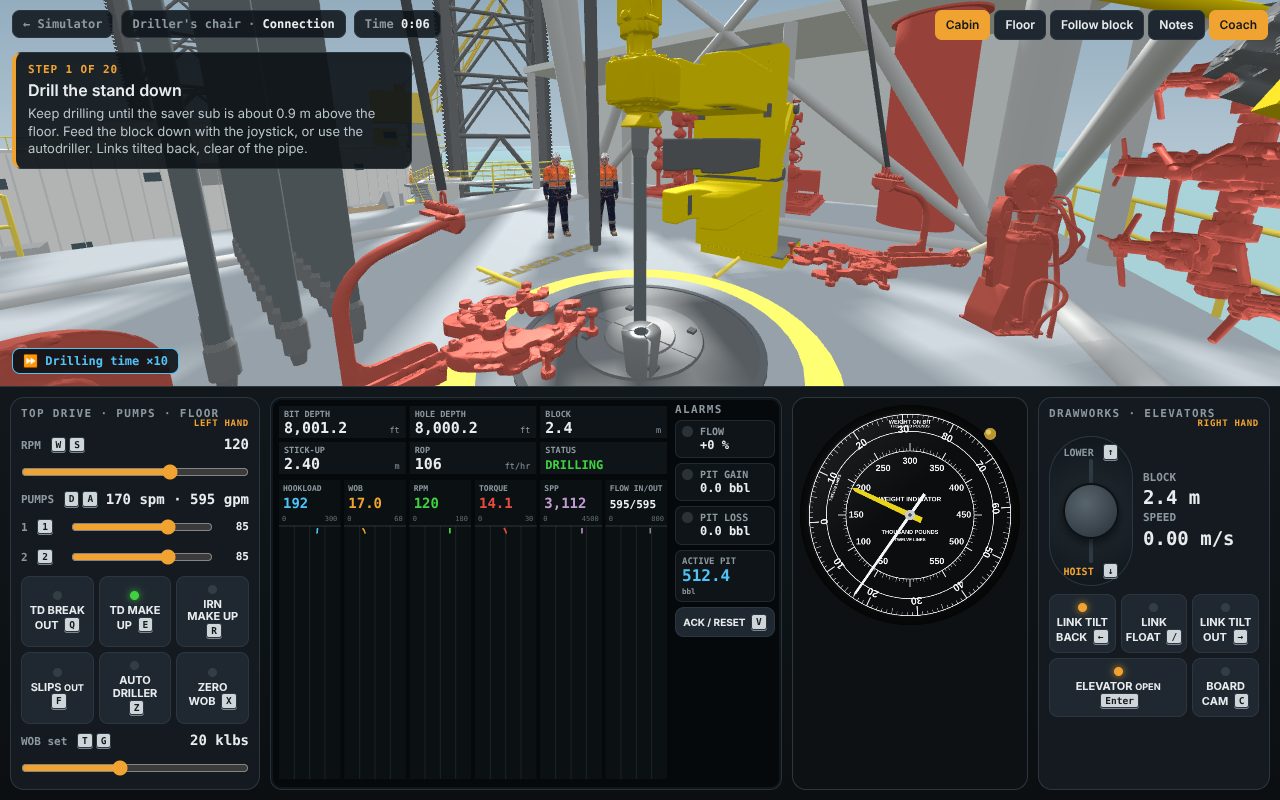
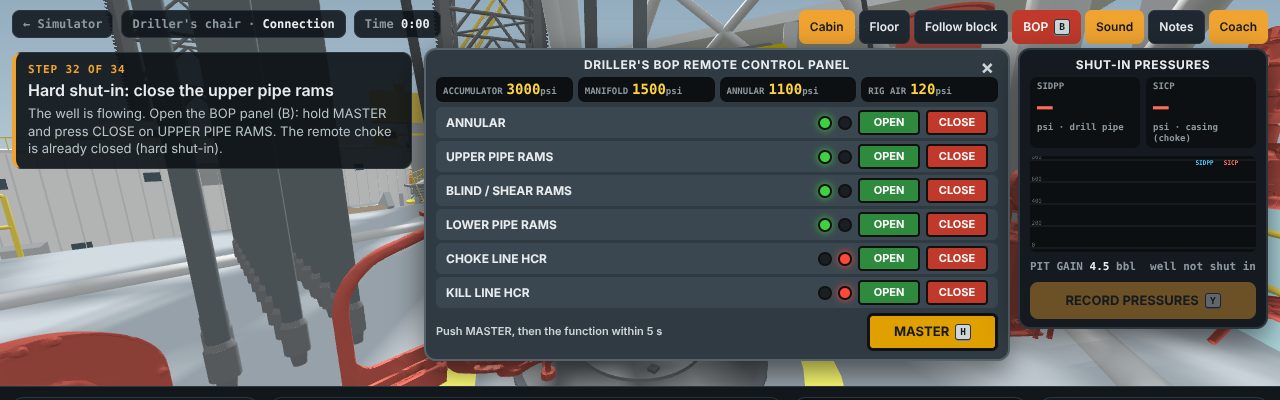
Sit in the cyber chair and drill. Drawworks joystick in your right hand, top drive, pumps and slips on the left, a driller's trace screen, alarms and a weight indicator in the middle. Drill the stand down, work it, make the connection with the derrickman and floor crew, then get back to drilling. When you're ready, drill on into a kick and shut the well in on the BOP panel. Or trip in the hole on elevators and keep the trip sheet.
Real hookload, WOB, torque and pressure behaviour, with sound
Keyboard controls like a game (arrows for the block, W A S D for rotary and pumps)
Coached steps, supervisor's notes and a score for every connection
Trip in the hole on elevators: pick up stands from the derrickman, make them up with the iron roughneck, run in, and check the displacement on the trip sheet with the calculator
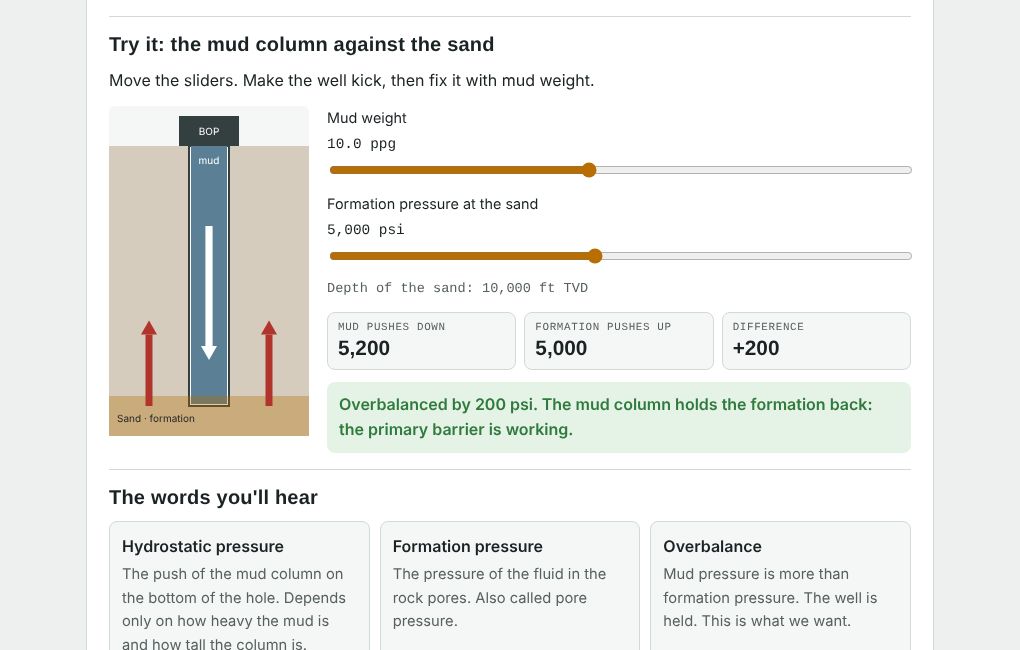
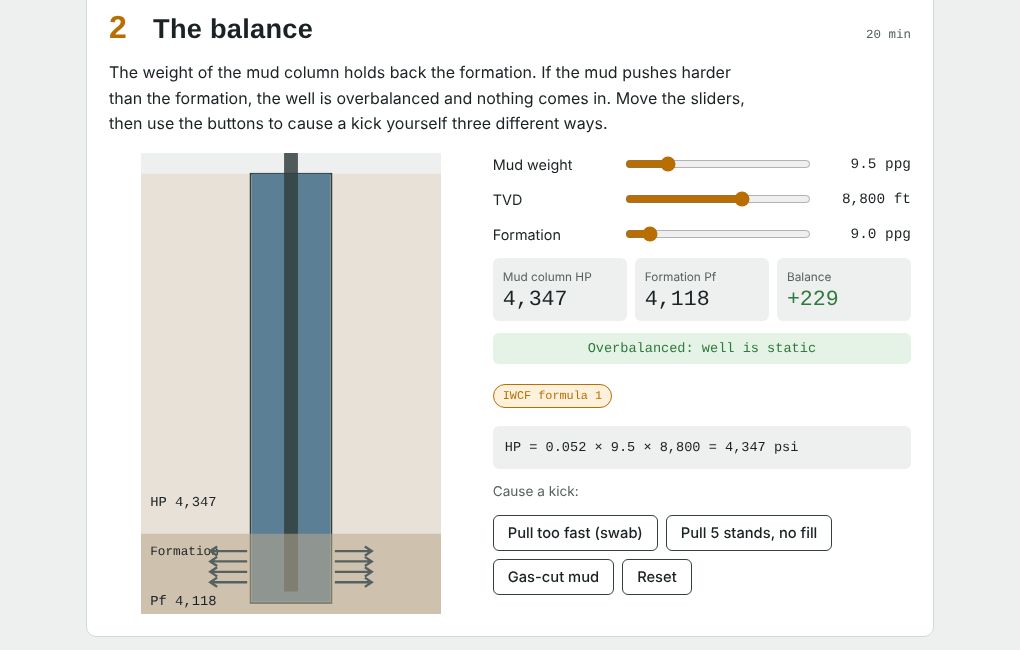
Every session is hands-on. You move the sliders and watch a well kick, read the driller's screen and decide what to do, sort barriers, work the kill sheet box by box with the calculator steps shown, then see it happen on the BB17 rig simulator. Nothing to memorise blind: you find out why it works, then you check yourself.
Is this for you?
Well control doesn't come easy to everyone.
It's made for the hands who find it hardest.
You find well control hard to get your head around. We start with what you see on the rig and build up from there, one idea at a time.
The formulas and the kill sheet lose you. Every calculation is worked step by step, on the calculator, rounded the way the exam rounds.
You have to resit a module. Go straight to the sessions that cost you marks and practise them until they stick.
It's your first ever exam, or the first since school. Practise under exam conditions at home, so the real day holds no surprises.
No one is watching and nothing is timed unless you want it to be. Go over a session as many times as you need.
Built for junior handsRoustabouts, floormen and derrickmen get the words, the pictures and the reasons in plain language, so the first course isn't a wall of formulas.
A lead-up to the courseUse it before your accredited well control course to arrive prepared: the principles, the gauges, the shut-ins and the kill sheet already make sense.
Learn at your own paceShort sessions on your phone or laptop, between hitches or on nights off. Your progress is saved, with a knowledge check at the end of each one.
Every answer explainedWrong answers get a full review, worked calculations rounded the way the exam rounds them, and practice questions written for BB17.
Rig crew · 8 sessions
Level 2 preparation
For roustabouts, floormen and derrickmen. What holds the well back, the warning signs, your job when the alarm goes and how the BOP works, in pictures and plain words.
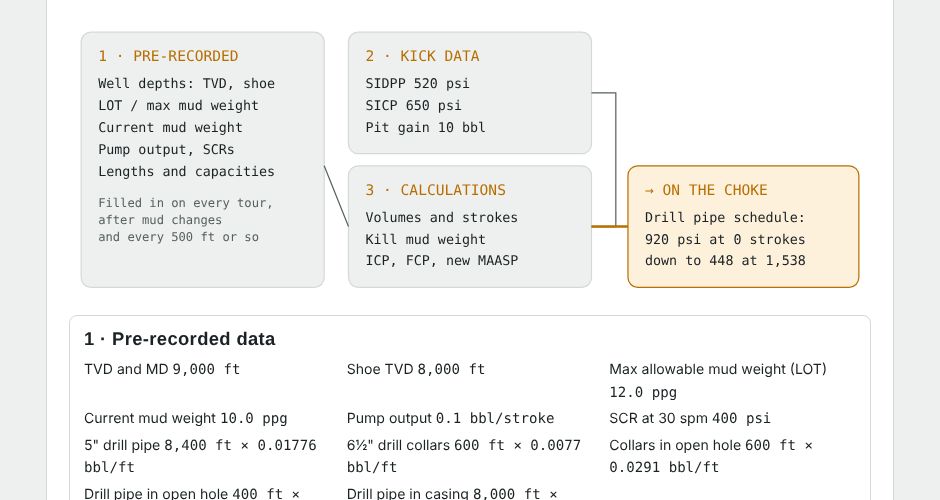
The driller's course: kick detection, shut-ins, SIDPP and SICP, the BOP and accumulator, the Driller's method, the kill sheet and two full mock exams, plus a rehearsal on the simulator.
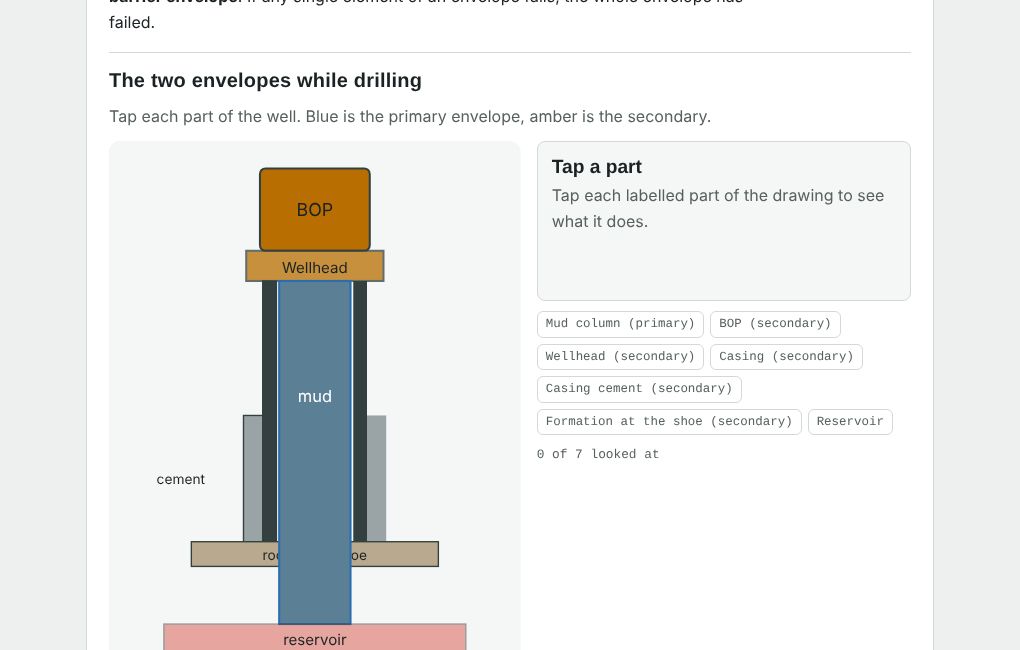
For the people who run the well: barrier envelopes, kick tolerance, kill methods and their complications, well control equipment and the decisions behind them, with a 30-question mock.
Moving from land to offshore? See Rig training. These are preparation courses with our own practice questions. They help you get ready for an accredited well control course and assessment; they don't replace it.
Crew build one profile, read in a minute, and choose who sees it. Companies search the crew who have opted in. Free to use: register once and everything on RigVoyage opens.
For crew
Find your next rig
Roustabout to drilling supervisor, land or offshore.
Crew profiles
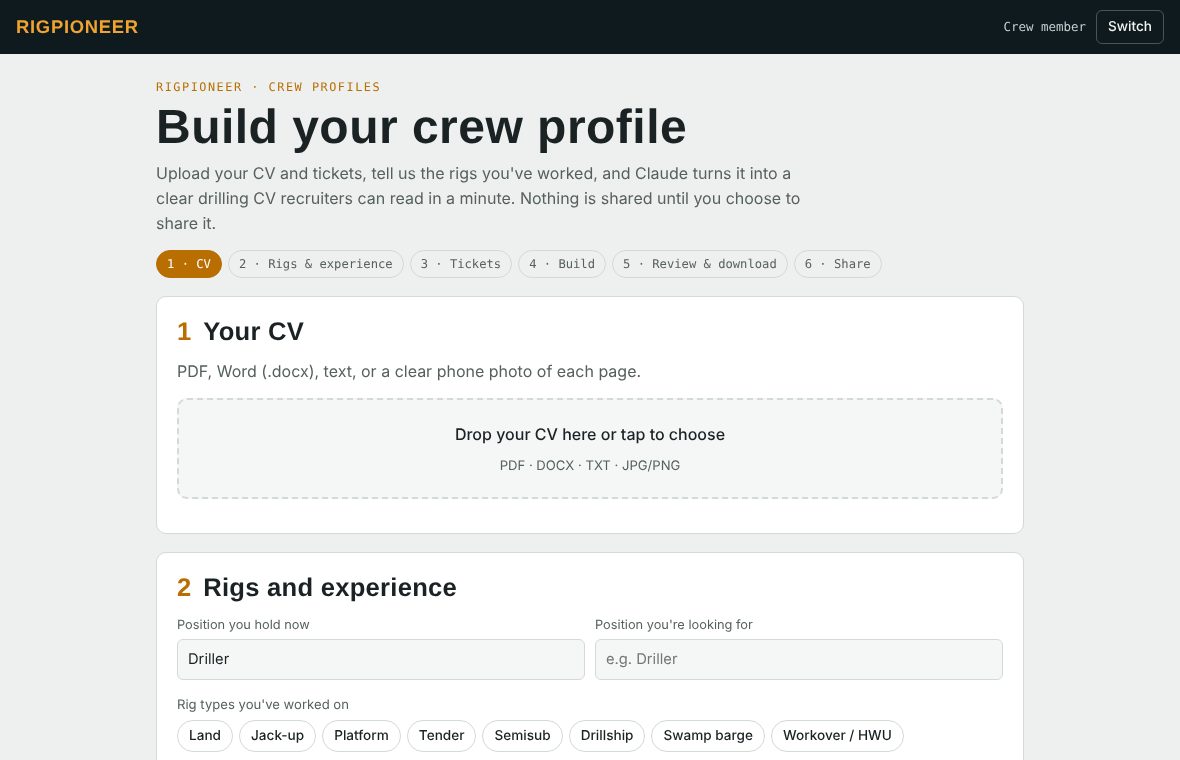
Upload your CV and tickets, tell us the rigs you've worked, and Claude lays it out in the RigVoyage crew format: units, rig types, years, and every ticket with its expiry date.
Works from a PDF, a Word file or a phone photo of each page
Tickets flagged when they're close to expiring
Employers see your first name and initial only
Say which positions you'd step down to, to get on a rig
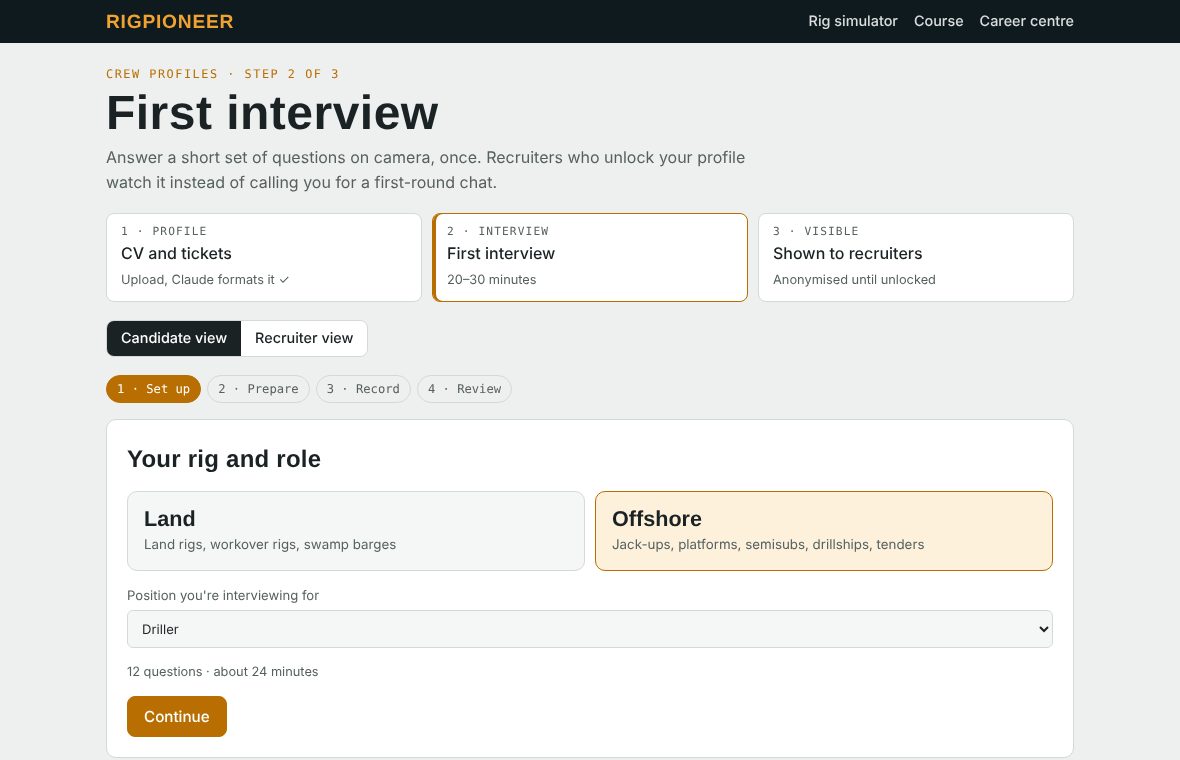
Answer a short set of questions for your position on camera, once, on your phone. About 20 to 30 minutes. Recruiters watch it instead of calling you for a first-round chat.
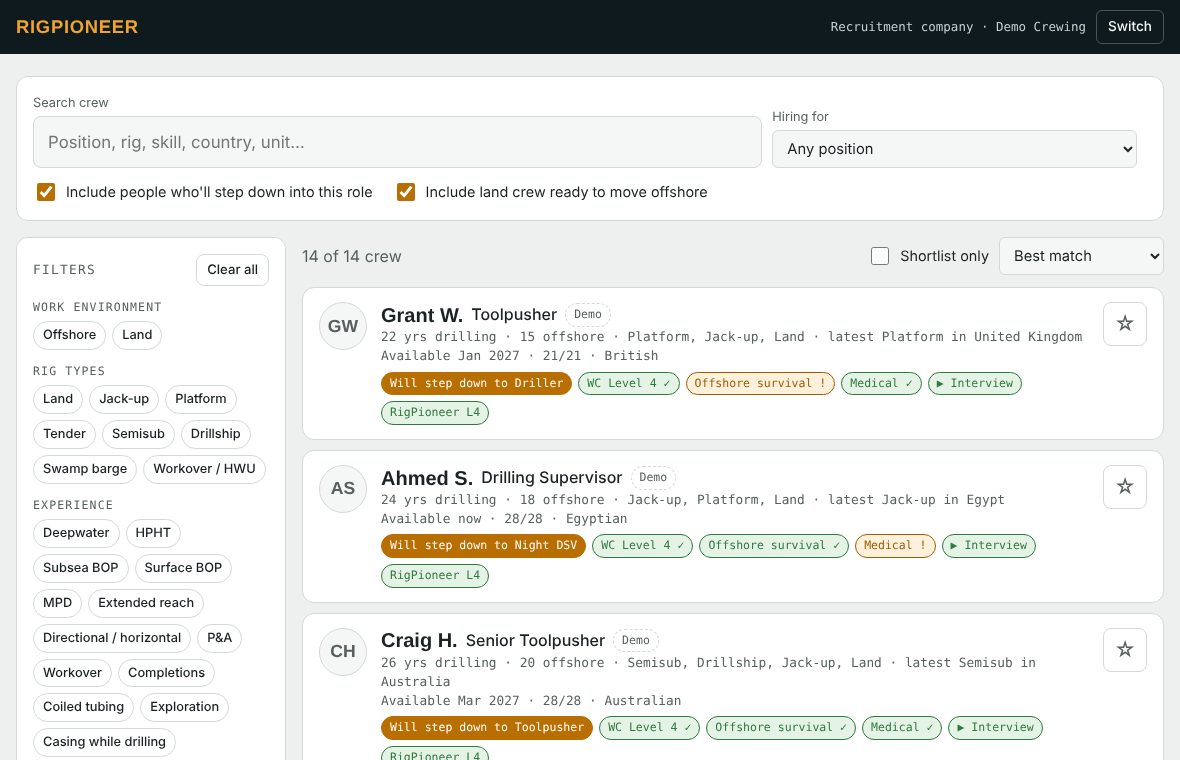
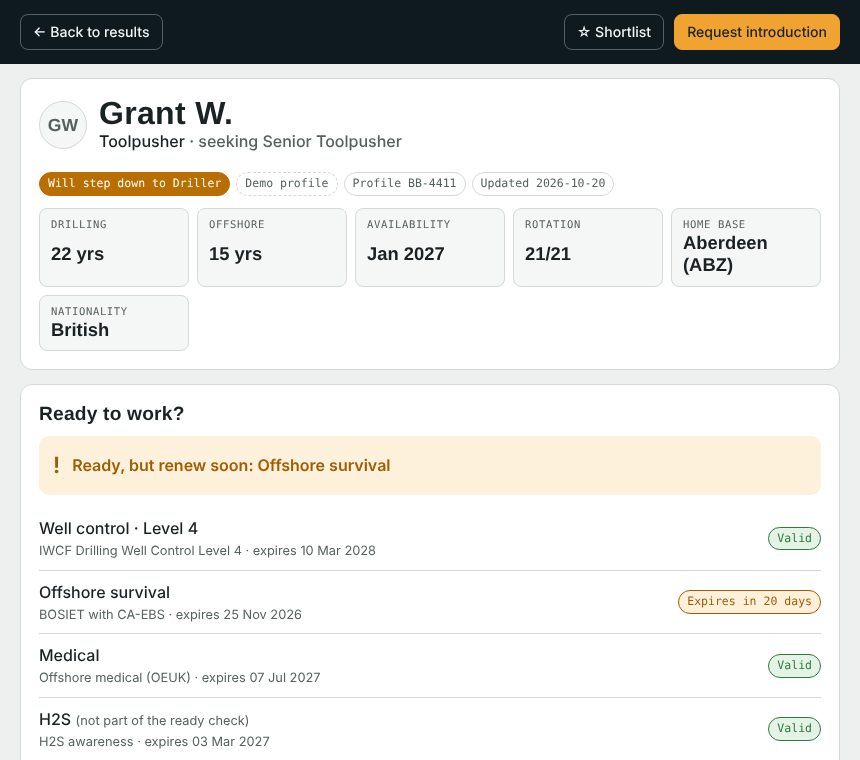
Every profile is in the same format: units worked, rig types, years in drilling, and a ready-to-work check of every ticket. RigVoyage course badges and first-interview videos are shown on the profile.
Anonymised until you ask for an introduction
Contact details released through RigVoyage
You see which crew have passed which courses
How hiring works
Register as a company and search crew.
Shortlist and ask for an introduction.
RigVoyage puts you in touch.
For both · where the work is
Rig Locator
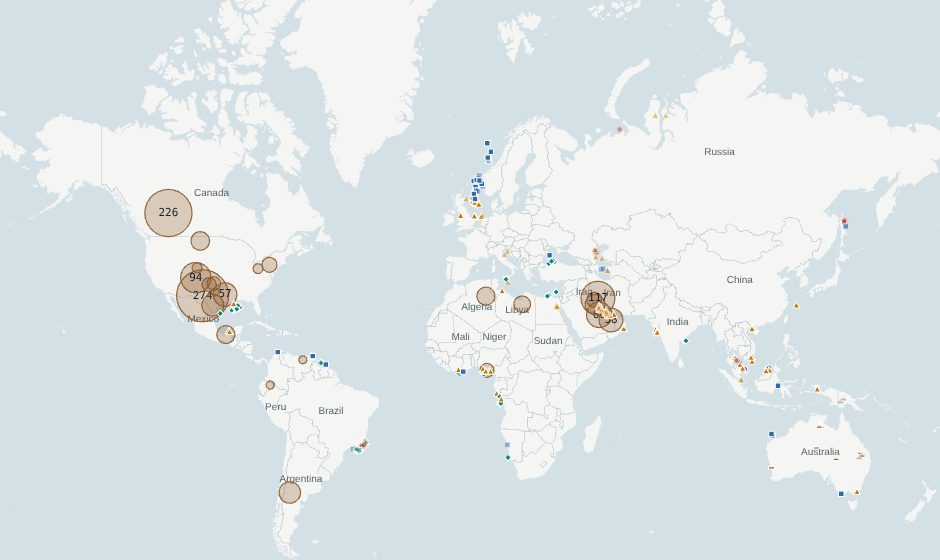
See where the rigs are working: offshore rigs by type on a world map, and land rigs by country and basin. Crew can see where to apply; companies can see where the activity is.
Two free, interactive courses. Rig Launch is for people who have never worked on a rig and want to get a start. Land to offshore is for land crews making the move offshore.
Rig Launch · Introduction to the rigs
Your first step onto a rig
Written for school leavers, tradespeople and career changers who want a job on a drilling rig and don't know the words yet. It explains what a rig does, the jobs and how people move up, what life on a roster is really like, the safety rules that keep you alive, the equipment, what a new start does in the first days, and how to get hired. Plain English, every rig word explained the first time it comes up.
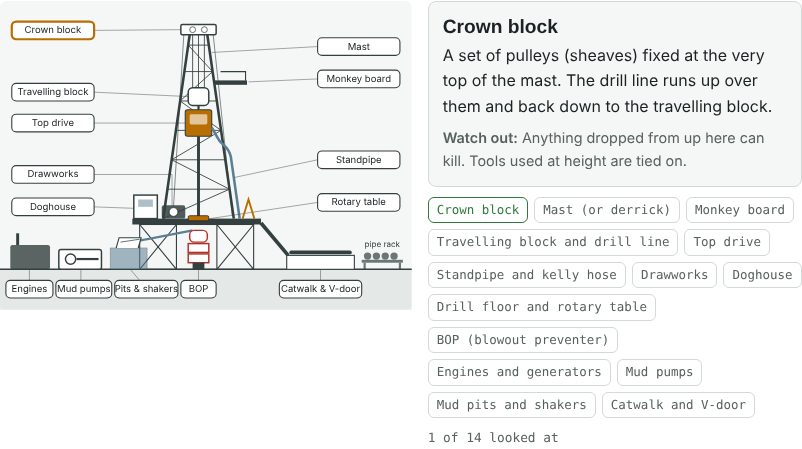
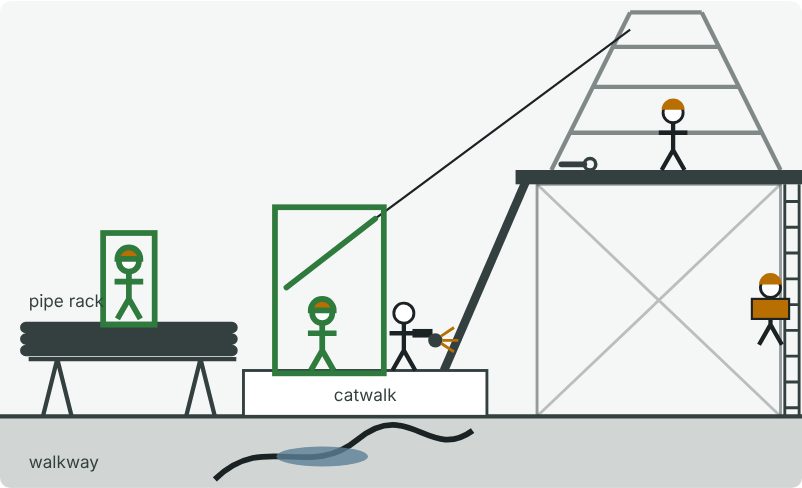
Tap-the-part rig diagrams, spot-the-hazard pictures, sorting and step-in-order drills
Links into the BB17 simulator, including the rig tour and the driller's chair
Scenario questions in every module, a 25-question final check and a Rig Ready badge
It gets you ready to start. It doesn't replace the safety tickets, medicals and inductions your region and employer require.
Rig Launch: eight modules, from zero to your first day
What a drilling rig doesWhere oil and gas come from, what a well is, land rigs and offshore rigs, and the life of a well from spud to moving on.
Jobs on the rigLeasehand to toolpusher, the support crew and the service hands, what each does in a day and how you move up.
Life on the rigRosters and swings, twelve-hour tours, camps, fatigue, drug and alcohol testing, and being away from home.
Safety basicsHow people get hurt, PPE, stop-work authority, JSAs and permits, the red zone and H2S.
Rig equipmentThe five systems, the pipe that goes in the hole and the tools you'll handle on the floor.
Your first days on the rigThe induction, what a new start does, how a connection is made, hand signals and talking to the driller.
Getting hiredTickets, a rig CV, applying, the interview, what to bring and the scams to avoid.
Final check and badgeTwenty-five scenario questions. Score 80% to earn the Rig Ready badge.
Land to offshore
From land rigs to offshore.
This course was built for land drilling crews making the move offshore. You already know the job: tripping pipe, making connections, mixing mud, working the floor. What's new is everything around it. You fly or sail to work, you live on the rig for weeks, every joint and sack arrives by boat and crane, the BOP and the emergency plan are different, and if it goes wrong there is nowhere to drive away. The course takes what you already know from land and shows you what changes offshore, so your first hitch isn't a shock.
How it was developed
Written from the land crew's side
Every module starts from a situation a land hand recognises, then shows the offshore difference: driving to the rig against flying out on a helicopter, a land BOP against one that may sit on the seabed, running to the muster point against waiting for the lifeboat. It covers the things that catch land hands out on their first hitch.
Pick your job and get a role track: roustabout, floorhand, derrickman, assistant driller or driller
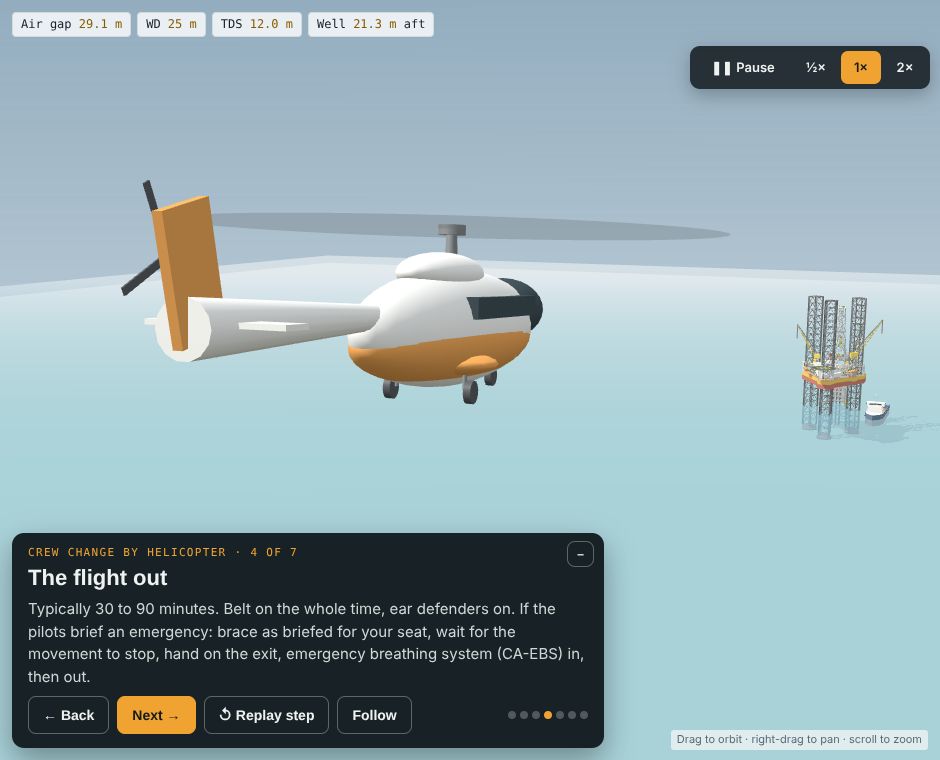
Simulator scenes built in: the helicopter crew change, the rig tour, the crane transfer by boat and basket, and the muster and lifeboat
Scenario questions in every module, and an Offshore Ready badge at the end
Nine modules, heliport to drill floor
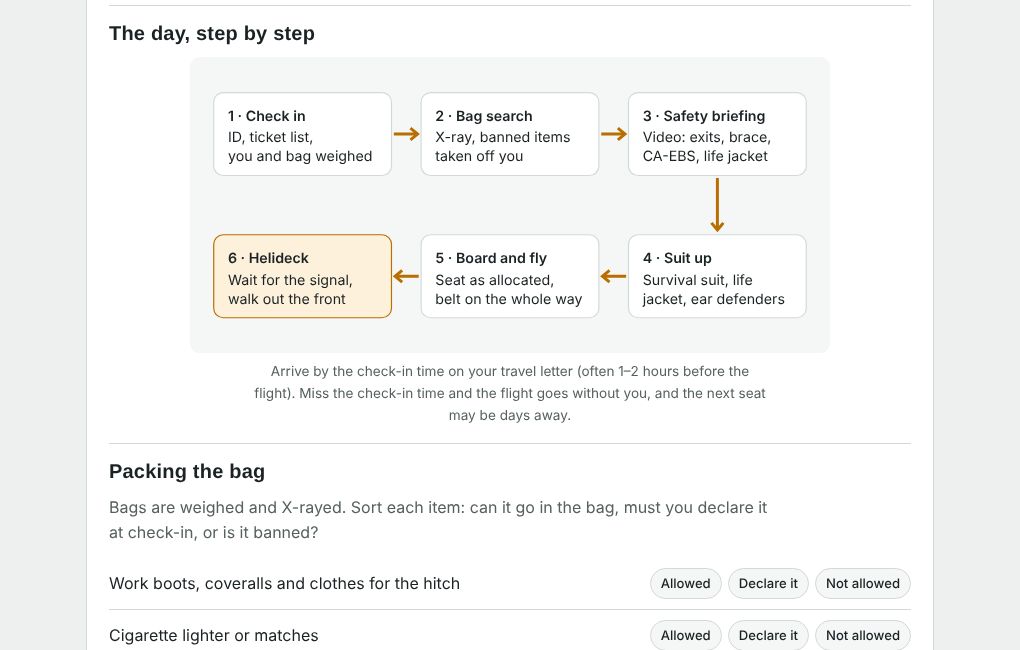
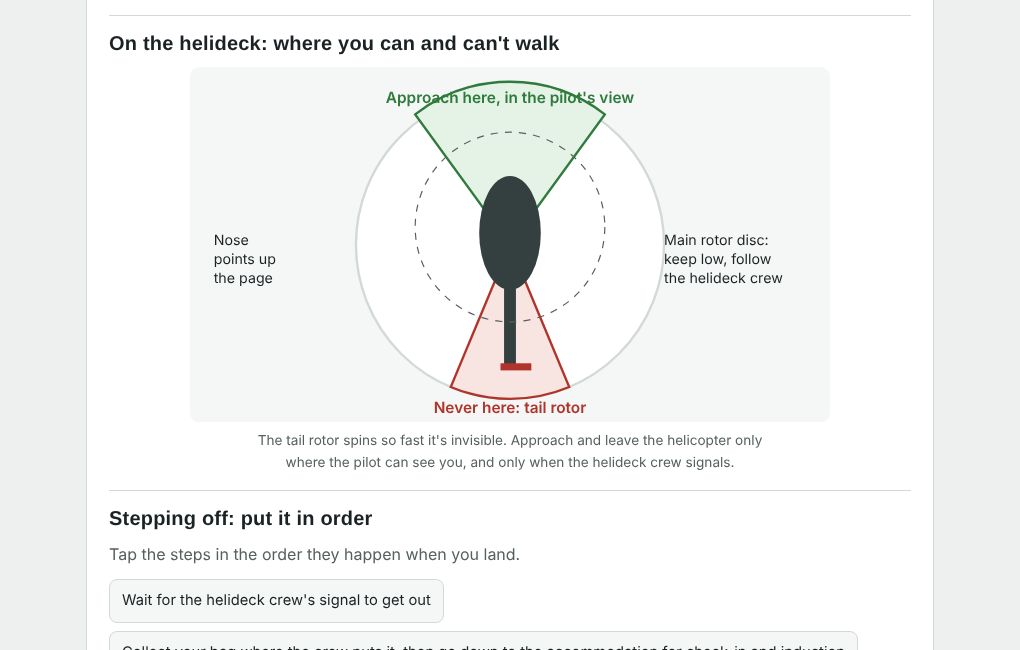
Getting thereCheck-in, what you can pack, the safety briefing, the survival suit, the flight and stepping off on the helideck. Plus the crew boat, basket and gangway.
Arrival and inductionThe induction, POB and the T-card board, the alarms, your muster point and lifeboat seat, and who runs the rig.
Living on the rigTwelve-hour tours for two to four weeks, a shared cabin, a galley that never closes, and looking after yourself through a hitch.
Rig layoutA land rig, pipe yard, mud plant, warehouse and hotel on one deck standing on its legs, and how floaters differ.
Safety offshoreEverything you know from land, plus the sea, the cranes, dropped objects, permits and the distance from help.
Drill floor and operationsThe same drilling job, but every joint, sack and barrel comes by boat, and deck space is counted. Role track for your job.
Well control offshoreKicks behave the same; the equipment and the stakes change: the BOP stack, the diverter for shallow gas, more drills and tests. Role track for your job.
EmergenciesThe alarms, the muster, the lifeboat, abandoning the rig and survival in the water.
Final check and badgeTwenty-five scenario questions. Score 80% to earn the Offshore Ready badge.
Who it's for
Land hands heading offshore
For roustabouts up to drillers with land experience and no offshore time, crews who have a first offshore job lined up, and supervisors and recruiters who want to prepare new starts before they fly. It works on a phone, so it can be done at home before the hitch.
It prepares you for your first offshore hitch. It doesn't replace the mandatory offshore safety and survival training (such as BOSIET or the equivalent for your region), which you still need before you fly.